



If you have seen a worrying Facebook post about carbon monoxide alarms and started questioning the alarm in your own home, we completely understand.
We recently saw one too.
The post claimed that ordinary carbon monoxide alarms could meet the recognised safety standard, work exactly as designed and still leave a family dangerously ill before sounding.
That is a frightening thought.
Rather than dismissing the post (or accepting everything in it because it sounded convincing) we decided to check the figures for ourselves. The Facebook post did something positive. It encouraged us to ask an important question:
Do the carbon monoxide alarms we fit warn people early enough?
Having looked into it properly, we feel reassured that they do.
We think there is some useful context that was missing from the post.
What was the Facebook post claiming?
The post did not say the alarms were faulty.
Instead, it argued that the recognised standard itself was not good enough. It suggested that carbon monoxide alarms wait until levels have already made people seriously unwell before sounding.
It also described a damaged boiler heat exchanger and claimed a family had been exposed to carbon monoxide throughout the night while their alarm remained silent.
There are a few key points we thought were important to think about:
- how carbon monoxide affects the body;
- how approved alarms decide when to sound;
- what a damaged heat exchanger can do;
- and what regular boiler servicing should identify.
We will take them one at a time.
Carbon monoxide levels are only half the story
Carbon monoxide (usually shortened to CO) is produced when a fuel such as gas, oil, coal or wood does not burn properly.
You cannot see, smell or taste it.
When breathed in, carbon monoxide reduces the blood’s ability to carry oxygen around the body. It can cause headaches, nausea, dizziness, tiredness and confusion. Severe poisoning can cause unconsciousness, heart or breathing problems and death.
However, the effect depends on both the amount of carbon monoxide and how long someone is exposed to it.
A brief reading at one level is not the same as breathing that level continuously for several hours.
Age, pregnancy, health conditions and physical activity can also affect how somebody responds. Children, pregnant women, older people and people with certain heart, lung or blood conditions may be more vulnerable. The UK Health Security Agency’s guidance on how carbon monoxide affects your health explains why the effects vary between individuals and depend on both concentration and exposure time.
When will the carbon monoxide alarm sound?
The FireAngel FA6813 that we normally fit monitors both the CO level and how long it remains present.
It is designed to sound:
| Carbon monoxide level | Alarm response |
| 50 ppm | Within 60–90 minutes |
| 100 ppm | Within 10–40 minutes |
| 300 ppm or higher | Within three minutes |
You may notice that the response becomes much faster as the concentration increases.
That is deliberate.
At a lower level, the alarm checks whether the reading continues. At a high and urgent level, it sounds almost immediately. These response times are set out in FireAngel’s instructions and reflect the requirements for approved domestic CO alarms.
FireAngel FA6812 & FA6813 User Guide
Would someone already be dangerously ill?
This is where the Facebook post becomes misleading.
FireAngel’s safety guidance gives these broad examples for a healthy adult:
- At 200 ppm, a slight headache, tiredness, dizziness or nausea may develop after around two to three hours.
- At 400 ppm, a frontal headache may develop within one to two hours. Continuing exposure may become life-threatening after around three hours.
- At 800 ppm, dizziness, nausea and convulsions may occur within about 45 minutes. Unconsciousness may follow within two hours, with death possible after two to three hours.
These are general guides, not a stopwatch. People respond differently, and any suspected carbon monoxide problem should be taken seriously.
These examples are consistent with the UKHSA Carbon Monoxide Toxicological Overview, which explains how both concentration and duration influence the severity of poisoning.
However, compare those times with the alarm response.
At 300 ppm or above, the alarm should sound within three minutes.
That is well before the exposure times normally associated with severe illness, unconsciousness or a threat to life in a healthy adult.
At 100 ppm, the alarm should sound within no more than 40 minutes. Again, that is very different from the suggestion that everybody inside would ordinarily be vomiting, confused or unable to leave before the alarm reacted.
So, does a correctly working approved alarm normally wait until it is too late?
No.
It is designed to warn people before acute exposure would normally become life-threatening. That said, particularly vulnerable people may be affected sooner, and standard alarms should not be treated as medical monitoring devices.
What about lower carbon monoxide levels?
This is the part of the online discussion that has some truth behind it.
A standard domestic CO alarm is primarily designed to protect against acute poisoning. It may not sound immediately at every very low reading.
That does not make the alarm useless or unsafe. It means it is measuring the combination of concentration and time rather than reacting to every brief trace.
However, lower-level exposure that continues over a long period can still cause headaches, tiredness, nausea and other vague, flu-like symptoms. That is one reason carbon monoxide problems can sometimes be difficult to recognise.
A digital alarm or one with additional low-level monitoring can provide more information. This may be reassuring for some households.
It is an additional feature, though. It is not proof that an approved alarm without a screen cannot protect a family from dangerous acute exposure.
What about the reported reading of 67 ppm?
The Facebook story referred to a reading of around 67 ppm after a family had reportedly been exposed throughout the night.
A reading taken at one moment does not tell us:
- what the level had been earlier;
- how long it had remained at that level;
- whether it had recently increased;
- whether the same level was present beside the alarm;
- whether the alarm was correctly positioned;
- or whether it was still within its working life.
If the alarm itself had genuinely been exposed continuously to more than 50 ppm throughout the night, a compliant FA6813 should have sounded within 60–90 minutes.
We cannot know exactly what happened from a Facebook advert.
That does not mean nobody was unwell. It simply means the information provided is not enough to prove that the recognised alarm standard failed.
What about the broken heat exchanger mentioned in the post?
The Facebook post blamed the problem on a broken boiler heat exchanger, which sounds understandably alarming.
The heat exchanger is the part inside your boiler that transfers heat from the burning gas into the water used for your heating and hot water.
However, a damaged heat exchanger does not automatically mean carbon monoxide will start entering the room.
Most modern gas boilers are room sealed. In simple terms, the part of the boiler where the gas burns is kept separate from the air in your home. The boiler takes in the air it needs from outside and sends the combustion gases safely back outside through the flue.
So, for carbon monoxide to escape from a modern room-sealed boiler into the property, there would usually need to be another problem as well. This could be a damaged seal, an issue with the boiler casing or combustion chamber, or a fault with the flue.
That does not mean a damaged heat exchanger is nothing to worry about. It still needs to be investigated and repaired. It simply means that saying, “the heat exchanger broke and filled the house with carbon monoxide,” leaves out some important parts of the picture.
Worcester Bosch has a straightforward explanation of how a boiler heat exchanger works if you’re unfamiliar with the component.
Would you notice a problem with the boiler first?
Quite often, yes.
A developing boiler problem may begin to affect how the appliance works before it creates a danger inside the home. You might notice it losing pressure, leaking water, making unusual noises, showing fault codes, locking out or becoming unreliable.
Those signs are the boiler’s way of telling you that something is not right, and they should not be ignored.
However, we would never advise relying on obvious symptoms alone. Not every fault announces itself clearly, and a boiler can appear to be working while still needing attention.
That is why regular servicing and a working carbon monoxide alarm are both important. The Gas Safe Register also recommends having gas appliances checked regularly by a Gas Safe registered engineer.
During a proper service, the engineer can check the condition of the boiler, its seals, the flue and how safely it is burning. The alarm then provides a separate layer of protection should something develop between services.
No single safety measure does everything. The boiler’s room-sealed design, regular servicing and a correctly fitted carbon monoxide alarm all work together to help keep your home safe.
What Housewarmers provides
Having reviewed the figures, we remain confident in the FireAngel FA6813 that we normally fit.
It has:
- an electrochemical carbon monoxide sensor;
- a ten-year sensor life;
- replaceable batteries;
- a loud audible warning;
- an alarm-memory function;
- and compliance with EN 50291-1:2018.
It is a suitable domestic carbon monoxide alarm. The fact that it does not have a numerical screen does not mean it waits until someone is close to death before warning them.
We also understand that some customers would feel more comfortable seeing what the alarm is detecting.
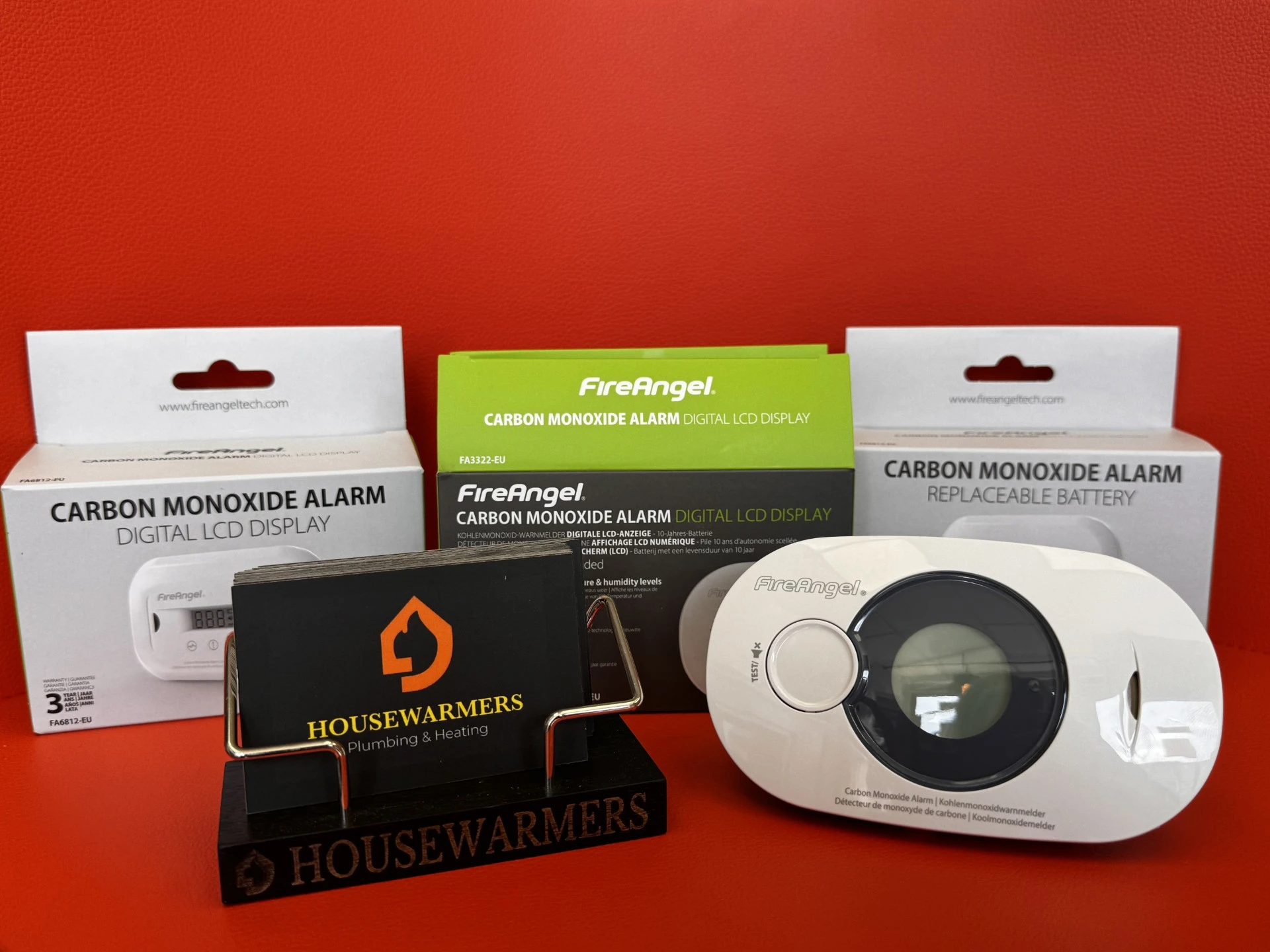
For that reason, we can also offer:
FireAngel FA6812
The FA6812 has a compact digital display showing carbon monoxide readings. It has a ten-year sensor and user-replaceable batteries.
FireAngel FA3322
The FA3322 is a premium model with low-level CO monitoring, a colour-changing digital display and a sealed ten-year battery. It can also display temperature and humidity information.
We are not going to tell every customer that they must buy the most expensive alarm.
Instead, we will explain the differences honestly and help them choose the level of information and reassurance that suits their home.
Should you replace your existing carbon monoxide alarm?
You do not need to throw away a suitable alarm simply because of something you have seen online.
Check:
- that it meets BS EN 50291;
- that it is still within its replacement date;
- that it is positioned according to its instructions;
- and that it responds correctly when tested using the test button.
Replace it if it is expired, faulty, damaged or does not carry a recognised approval.
A digital model may be worth considering if you would value visible readings or additional low-level information. But it is an optional upgrade, not an admission that every standard alarm is unsafe.
What should you do if your alarm sounds?
Never ignore a carbon monoxide alarm.
The Health and Safety Executive’s carbon monoxide safety advice also recommends leaving the property immediately and seeking professional assistance if an alarm activates.
Leave the property and call the National Gas Emergency Service on:
Do not return until you have been told it is safe.
Anyone who feels unwell or thinks they may have been exposed should seek medical help and explain that carbon monoxide may be involved.
Do not use the suspected appliance again until it has been inspected and confirmed safe.
What did we conclude?
The Facebook post asked a fair question:
Does an approved carbon monoxide alarm warn people early enough?
Having looked at the alarm timings and the usual effects of exposure, we feel reassured that it does.
At high and immediately dangerous levels, the alarm responds very quickly. At lower levels, it considers how long the reading continues.
The claim that a correctly working approved alarm will routinely leave a healthy adult close to death before sounding is not supported by the published timings.
Low-level exposure still matters. Boiler faults still matter. Regular servicing still matters.
That is why we believe the right approach is not to frighten people into buying a particular product. It is to combine:
- properly maintained appliances;
- appropriate ventilation and clear flues;
- a genuine, in-date and correctly positioned CO alarm;
- and clear advice when something does not seem right.
If something you have seen online has left you worried about your carbon monoxide alarm, please ask us.
At Housewarmers, we would always rather investigate a concern, explain what we find and help you make an informed decision than sell you something through fear.
Still have questions about your carbon monoxide alarm?
If something you’ve seen online has left you unsure whether your carbon monoxide alarm is suitable, or you’re concerned about your boiler, we’re happy to help.
Whether you need advice, a replacement carbon monoxide alarm, or a Gas Safe boiler service, our experienced engineers can check everything is working safely and give you honest, straightforward recommendations – without the scare tactics.
Call Housewarmers today or request a free callback. We’re always happy to answer your questions.